
What is the best diet for a long life?
On this page
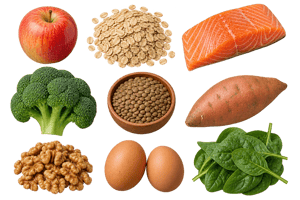
No branded diet wins. In 119,315 Americans followed for up to 36 years, four different healthy eating patterns each went with about 15 to 20% lower risk of dying. The best-tested of them rewards vegetables, fruit, beans, nuts, whole grains and fish, and marks down processed meat and sugary drinks.
What we’d do
Build most meals around vegetables, beans and whole grains, add fruit, nuts and fish, and keep processed meat, soda and packaged snacks rare. Then pick the version you’ll actually eat for the next 30 years, Mediterranean, plant-based or plain American, because they all did about as well.
Why it feels like you have to pick a side
Diet books sell certainty. Each one has a villain (carbs, fat, meat, lectins) and a name you can put on a shopping list. Online it turns into teams. The long studies tell a quieter story, and it’s the same one each time.
Four diets, one result
In 2023, Harvard researchers scored the diets of 75,230 women and 44,085 men on four different healthy eating scores and followed them for up to 36 years. Comparing the top fifth with the bottom fifth on each score, the risk of dying was:
| Eating pattern | Risk against the bottom fifth |
|---|---|
| The US Dietary Guidelines score | 19% lower |
| Mediterranean | 18% lower |
| Healthful plant-based | 14% lower |
| Alternate Healthy Eating Index | 20% lower |
Each was also linked to fewer deaths from heart disease, cancer and lung disease, and the results held for Hispanic, Black and White Americans.
What the best-tested score rewards
The Alternate Healthy Eating Index is the score the Harvard habits study used. You score higher for more vegetables, whole fruit, whole grains, nuts and beans, fish oils and the fats in nuts, seeds and vegetable oils. You score lower for sugary drinks and fruit juice, red and processed meat, trans fat and salt.
One quirk is that the index also gives points for moderate drinking. We don’t follow it there, since later work found light drinking doesn’t add years. See does drinking shorten your life.
The simple version
The healthy diets are different trails up the same hill. They start in different places, from a Greek kitchen to a plain American one, and the long studies found they reach about the same height.
How many years?
In the Harvard habits study of 123,219 adults, people in the top fifth for diet quality had 37% lower risk of dying than people in the bottom fifth. In our calculator, a 50-year-old who goes from mostly packaged or fast food to mostly whole foods gets back about 3 to 4 years.
Diet works alongside the other habits. The same study found that exercise and not smoking carried bigger differences. For the famous long-lived villages, see are blue zones real, and for eating much less, does eating far less make you live longer.
3 sources
- Shan Z and others, Healthy Eating Patterns and Risk of Total and Cause-Specific Mortality, JAMA Internal Medicine, 2023pubmed.ncbi.nlm.nih.gov
- Chiuve SE and others, Alternative Dietary Indices Both Strongly Predict Risk of Chronic Disease, Journal of Nutrition, 2012pmc.ncbi.nlm.nih.gov
- Li Y and others, Impact of Healthy Lifestyle Factors on Life Expectancies in the US Population, Circulation, 2018pmc.ncbi.nlm.nih.gov