How long should you be able to stand on one leg?
On this page
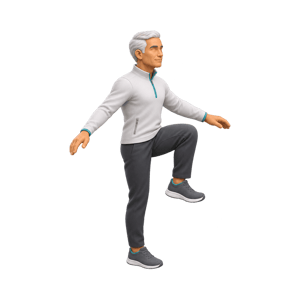
At least 10 seconds if you’re over 50, with your free foot resting against the back of the other calf and your arms at your sides. In 1,702 adults aged 51 to 75, one in five couldn’t, and over the next 7 years they had 84% higher risk of dying than those who could.
What we’d do
Test it now, barefoot, next to a counter you can grab. Take up to three tries on each foot. If you can’t hold 10 seconds, practice every day, standing on one leg while you brush your teeth, and add leg strength work. Retest in 8 weeks. Ten seconds is a typical target, and the Gyroscope app personalizes yours.
Why balance sneaks up on people
You don’t think about balance until it fails, because you use it all day without noticing. It falls off quickly after the mid-50s, and if you never test it, the first sign can be a stumble or a fall. A 10-second test can catch it first.
How to do it
- Stand barefoot near a wall or counter.
- Lift one foot and rest its front against the back of your other lower leg.
- Keep your arms at your sides and look straight ahead.
- Hold for 10 seconds without touching anything. Take up to three tries on either foot.
The floor test records it beside the sit-rise and dead hang, and gives you a date to test again.
The simple version
The one-leg test works like a smoke alarm. It doesn’t cause the fire, but when it goes off, it’s telling you to look at what’s behind it.
What the study found
Claudio Gil Araújo and his colleagues tested 1,702 adults in Brazil, aged 51 to 75, between 2008 and 2020. Overall, 20.4% couldn’t hold 10 seconds. Over a median of 7 years, 17.5% of those who failed died, against 4.6% of those who passed. After adjusting for age, sex, BMI and health conditions, failing went with 84% higher risk.
The share who couldn’t do it climbed steeply with age:
| Age | Couldn’t stand 10 seconds |
|---|---|
| 51 to 55 | about 5% |
| 56 to 60 | 8% |
| 61 to 65 | just under 18% |
| 66 to 70 | just under 37% |
| 71 to 75 | about 54% |
By the early 70s, half the people tested couldn’t do it.
What the test is really measuring
Standing on one leg pulls together your inner ear, your eyes, the sensors in your feet and ankles, the strength in your hips and legs, and how fast your brain corrects a sway. When one of those slips, you start to wobble.
The study couldn’t account for recent falls or how active people were, and everyone tested was white and Brazilian. It shows a link, and nobody has tested whether training balance adds years. But balance training does prevent falls. A Cochrane review of 108 trials found exercise built around balance and everyday movements cut falls by 23% in older adults living at home.
3 sources
- Araujo CG and others, Successful 10-second one-legged stance performance predicts survival in middle-aged and older individuals, British Journal of Sports Medicine, 2022pubmed.ncbi.nlm.nih.gov
- University of Eastern Finland, Inability to stand on one leg for 10 seconds in mid to later life linked to near doubling in risk of death, 2022uef.fi
- Sherrington C and others, Exercise for preventing falls in older people living in the community, Cochrane Database of Systematic Reviews, 2019pubmed.ncbi.nlm.nih.gov