How do you keep your healthy years?
On this page
Train the things that decide whether you stay independent: leg strength, balance, walking speed and grip. Each one predicted how long older adults lived in big studies, and each responds to training, even in people in their 90s. Americans spend about 12 years of life in poor health, more than people in any other country.
A lot of people ease off as they get older, to be safe. They stop lifting, avoid the stairs and let someone else carry the bags. The tests that predict independence all reward the opposite.
What we’d do
From 50 on, train for the last ten years of your life. Lift twice a week with your legs first, practice balance every day, walk briskly, and carry heavy things. Take the floor test every few months so you notice a slide early.
If you remember three things
- Americans spend about 12.4 years in poor health, the widest gap between lifespan and healthy lifespan of 183 countries.
- Walking speed predicts how long older adults live. In 34,485 people aged 65 and over, each extra 4 inches a second (0.1 meters) of walking speed went with a 12% lower death rate.
- Balance goes fast after the mid 50s. About 5% of people aged 51 to 55 couldn’t stand on one leg for 10 seconds, and 54% at 71 to 75.
What counts as a healthy year?
Researchers count it two ways. One is years without a major disease. In the Harvard cohorts, women with four or five healthy habits at 50 lived 34.4 more years free of diabetes, heart disease and cancer, against 23.7 for women with none. For men it was 31.1 and 23.5.
The other is what you can still do. Can you get up from the floor, climb the stairs, carry your shopping and walk to the shops? Those decide whether you live on your own, and they’re what this page is about.
A picture from daily life
Think of a fuel gauge with a red zone at the bottom. Getting out of a chair, climbing a flight of stairs and catching yourself when you trip each take a certain amount of strength and balance. Everyone’s gauge drops a little each decade. If you start with a full tank, you reach the red zone years later than someone who started at a quarter, and training refills it.
Can you build strength at 90?
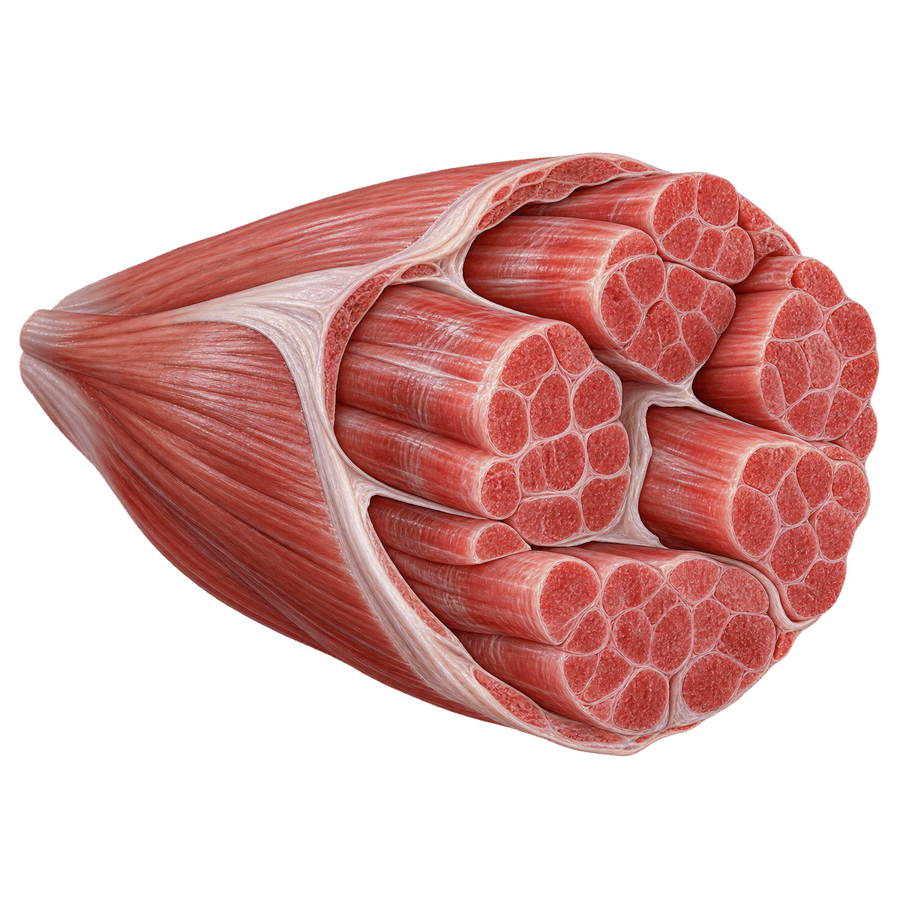
In 1990 a team led by Maria Fiatarone put ten frail nursing home residents, aged about 90 and up to 96, on 8 weeks of heavy leg training. Their strength rose by an average of 174%. Their thigh muscles grew 9%, and their walking speed in a heel to toe test rose 48%.
Four years later the same team ran a randomized trial in 100 nursing home residents with an average age of 87. Ten weeks of strength training raised strength by 113%, against 3% in the people who didn’t train. A nutrition shake on its own did nothing for their weakness.
What keeps you independent?
Leg strength
4,282 adults aged 46 to 75, followed a median 12.3 years. Araújo, European Journal of Preventive Cardiology, 2025
People who scored 0 to 4 out of 10 on getting up off the floor had 3.84 times the risk of a natural death of people who scored a perfect 10.
The test also needs balance and hip mobility, so it measures more than strength.
Balance
1,702 adults aged 51 to 75, followed a median 7 years. Araujo, British Journal of Sports Medicine, 2022
The fifth who couldn’t stand on one leg for 10 seconds had an 84% higher risk of dying.
The researchers couldn’t account for recent falls or how active people were.
Walking speed
34,485 adults aged 65 and over, in 9 studies, followed 6 to 21 years. Studenski, JAMA, 2011
Each 4 inches a second (0.1 meters) faster went with a 12% lower death rate. The average speed was about 3 feet a second (0.92 meters).
Walking slowly can be a sign of illness that’s already there.
Grip
139,691 adults in 17 countries, followed a median 4 years. Leong, Lancet, 2015
Each 11 pounds (5 kg) of weaker grip went with a 16% higher death rate.
Four years is short, so some weak grips may have been early illness.
Why does balance count so much?
Because falls are where independence often ends. More than 1 in 4 Americans aged 65 and over fall each year, and older adults’ falls lead to about 4.5 million emergency room visits a year. Nearly 319,000 older people are hospitalized for a broken hip each year, and in 2019, 88% of those hip fracture visits and hospital stays were caused by falls.
Balance drops quickly after the mid 50s, as the study’s own numbers show.
Couldn’t stand on one leg for 10 seconds, by age
- 51 to 555%
- 61 to 6518%
- 71 to 7554%
Practice it the way you’d practice anything else. Stand on one leg while you brush your teeth, next to the sink, and switch legs each night.
What about a sharp mind?
The same habits show up here. In 147,374 US adults, 90 to 119 minutes a week of strength training went with a 27% lower death rate from diseases of the brain and nerves. In a 2025 review of step studies, the risk of dementia fell as daily steps rose, with most of the drop by about 5,000 to 7,000 steps. And blood pressure counts for the brain too. Each 20 points (mmHg) higher systolic at 40 to 69 went with more than twice the death rate from stroke.
How we’d train for it
- Legs twice a week. Squats to a chair, then lower, lunges, step ups and, if you have access, a leg press or weights. Go heavy enough that the last few reps are hard.
- Balance every day. One leg while you brush your teeth, then with your eyes closed once that’s easy, always next to something you can grab.
- Walk briskly most days. Fast enough that talking takes a little effort.
- Carry heavy things. Carry groceries, a bag of soil or a kettlebell. It trains your grip.
- Test every 8 weeks. The floor test, one leg, a timed walk over 13 feet (4 meters) at your normal pace.
Typical goals are a floor test score of 8 or more, 10 seconds on one leg, and two strength sessions a week. The Gyroscope app personalizes yours. If you’ve fallen recently or have a joint replacement, start with a physical therapist.
Isn’t decline just age?
The sceptic says
Everyone gets weaker. Training can’t stop aging, and the studies only show that people who were already strong lived longer.
The reply
Everyone does get weaker, and how fast varies a lot. The cohort studies can’t prove training caused the years. But the nursing home trials changed strength on purpose, in people up to 98, in 8 to 10 weeks. The decline is real, but people in their 80s and 90s still won back a lot of strength in a couple of months.
Your turn
Take the floor test and get a date to test again.
13 sources
- Garmany A and Terzic A, Global Healthspan-Lifespan Gaps Among 183 World Health Organization Member States, JAMA Network Open, 2024pubmed.ncbi.nlm.nih.gov
- Li Y and others, Healthy lifestyle and life expectancy free of cancer, cardiovascular disease, and type 2 diabetes: prospective cohort study, BMJ, 2020pmc.ncbi.nlm.nih.gov
- Studenski S and others, Gait speed and survival in older adults, JAMA, 2011pmc.ncbi.nlm.nih.gov
- Araujo CG and others, Successful 10-second one-legged stance performance predicts survival in middle-aged and older individuals, British Journal of Sports Medicine, 2022pubmed.ncbi.nlm.nih.gov
- University of Eastern Finland, Inability to stand on one leg for 10 seconds in mid to later life linked to near doubling in risk of death, 2022uef.fi
- Araujo CGS and others, Sitting-rising test scores predict natural and cardiovascular causes of deaths in middle-aged and older men and women, European Journal of Preventive Cardiology, 2025academic.oup.com
- Leong DP and others, Prognostic value of grip strength: findings from the Prospective Urban Rural Epidemiology (PURE) study, Lancet, 2015pubmed.ncbi.nlm.nih.gov
- Zhang Y and others, Long-term resistance training with all-cause and cause-specific mortality, British Journal of Sports Medicine, 2026pubmed.ncbi.nlm.nih.gov
- Ding D and others, Daily steps and health outcomes in adults: a systematic review and dose-response meta-analysis, Lancet Public Health, 2025pubmed.ncbi.nlm.nih.gov
- Centers for Disease Control and Prevention, Older Adult Falls Datacdc.gov
- Fiatarone MA and others, High-intensity strength training in nonagenarians. Effects on skeletal muscle, JAMA, 1990pubmed.ncbi.nlm.nih.gov
- Fiatarone MA and others, Exercise training and nutritional supplementation for physical frailty in very elderly people, New England Journal of Medicine, 1994pubmed.ncbi.nlm.nih.gov
- Lewington S and others, Age-specific relevance of usual blood pressure to vascular mortality: a meta-analysis of individual data for one million adults in 61 prospective studies, Lancet, 2002pubmed.ncbi.nlm.nih.gov