Why do bodies age?
On this page
Your cells take damage every day and fix most of it. As you get older the repairs fall behind, and scientists now list twelve ways that shows up, from errors in your DNA to worn out stem cells. Several drugs slow those changes in mice. In people, the things shown to add years are still the plain habits, like exercising and staying off cigarettes.
Aging feels like a clock, since it comes with birthdays, or like wear and tear on a car. The popular version adds one master cause, short telomeres or low NAD, that a pill can top up. The research looks different. There are many causes, they feed each other, and none has a pill that has added years to a human life.
What we’d do
Put your effort into what’s been shown in people, and ask two questions of every anti-aging claim. Was it tested in mice or in people? And did it change how long anyone lived, or only a number in their blood?
If you remember three things
- Aging is a dozen processes running at once. The 2023 list has twelve, and they push on each other.
- Mice aren’t people. Rapamycin added 9 to 14% to the lifespan of mice started in middle age. Nobody has tested it for lifespan in people.
- What’s been shown in people is plain. Fitness and the habits in the big Harvard study are tied to years lived. No anti-aging drug has a human lifespan result yet.
Isn’t aging just wear and tear?
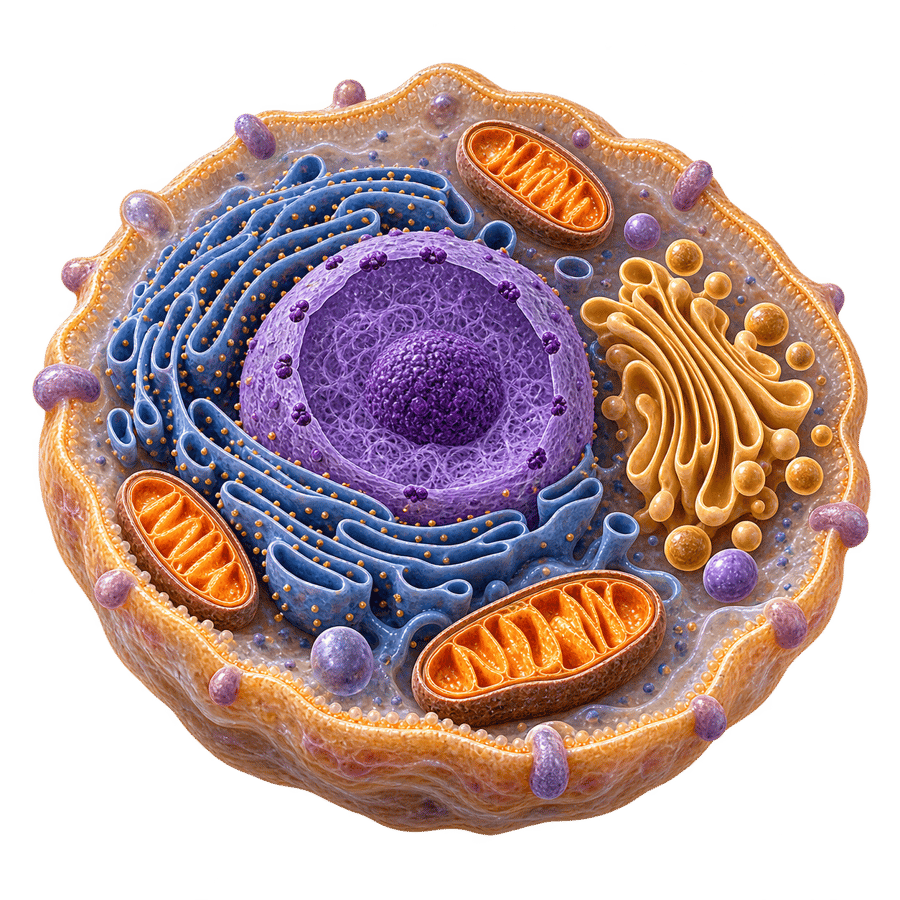
Partly, but a car can’t fix itself and your body does it all day. Cells copy and repair their DNA, refold proteins that bend out of shape, break down worn parts and reuse them, and replace cells that die. Aging is what happens when the damage starts to outrun the repairs, and the repair crews themselves get older.
A picture from daily life
Think of a city’s roads. Potholes open every day. A good road crew fills them as they appear, so the streets look fine for decades. Then the crew gets smaller and slower, more trucks use the road, and one winter the potholes start to win. Nothing broke all at once. The repairs just stopped keeping up.
What are the hallmarks of aging?
In 2013 five scientists led by Carlos López-Otín listed nine “hallmarks of aging”, changes that show up with age across many animals. In 2023 they updated the list to twelve. To count as a hallmark, a change has to appear with age, make an animal age faster when researchers make it worse, and slow aging when they fix it.
| Hallmark | In plain words |
|---|---|
| Genomic instability | Errors and breaks build up in your DNA |
| Telomere attrition | The caps on the ends of chromosomes get shorter as cells divide |
| Epigenetic alterations | The chemical tags that switch genes on and off drift out of place |
| Loss of proteostasis | Proteins fold the wrong way and clump |
| Disabled macroautophagy | Cells get worse at breaking down and reusing their own worn parts |
| Deregulated nutrient sensing | The signals that tell cells food is plentiful and to grow, such as insulin and mTOR, get out of balance |
| Mitochondrial dysfunction | The parts of cells that turn food into energy work less well |
| Cellular senescence | Damaged cells stop dividing but don’t die, and send out signals that inflame the cells around them |
| Stem cell exhaustion | There are fewer spare cells to replace worn ones |
| Altered intercellular communication | The signals between cells and organs get noisier |
| Chronic inflammation | Low level inflammation that doesn’t switch off |
| Dysbiosis | The mix of bacteria in your gut changes |
The last three are the ones added in 2023, along with the cell recycling one. The authors describe them as interconnected, so changing one often changes others.
What slows aging in mice, and what about people?
In 2009, three labs fed rapamycin to genetically mixed mice that were already 600 days old, late in life for a mouse. Females lived 14% longer and males 9% longer, measured at the age when 90% had died. The authors wrote that these were the first results to show a drug extending lifespan in both male and female mammals. Two years later the same group found that resveratrol, the red wine compound, did nothing for survival.
Rapamycin
Genetically mixed mice at three labs. Harrison, Nature, 2009, and Miller, Journals of Gerontology, 2011
Started at 600 days, it added 14% for females and 9% for males. Started at 9 months, median survival rose 10% in males and 18% in females.
There’s no lifespan trial in people.
Eating less
960 genetically diverse female mice. Di Francesco, Nature, 2024
Calorie restriction and fasting both extended lifespan, more with more restriction. Genes made a bigger difference to lifespan than the diet did.
The strictest diet cost the mice lean mass and changed their immune cells. In people, a 2-year trial measured markers and never got to years lived.
Clearing old cells
14 people with a scarring lung disease. Justice, EBioMedicine, 2019
The first human trial of drugs that clear senescent cells. Walking distance and speed improved after three weeks of the drugs.
There was no placebo group, and everyone knew what they were taking.
NAD boosters
Healthy middle-aged and older adults, and women with prediabetes. Martens, 2018, and Yoshino, 2021
Nicotinamide riboside raised NAD levels over 6 weeks. NMN raised muscle insulin sensitivity over 10 weeks.
Neither has been tested for lifespan in people.
Exercise
123,219 US health professionals, up to 34 years. Li, Circulation, 2018
3.5 to 6 hours a week of moderate or vigorous activity went with half the death rate of none.
This followed people rather than assigning them, but it measured years lived, in humans.
Why can’t you just measure your telomeres?
Because longer isn’t always better. A 2017 study used the genes that set telomere length, so it could see what longer telomeres do without the confusion of lifestyle. People born with genes for longer telomeres had higher rates of several cancers, about 3 times the odds of lung adenocarcinoma and nearly twice the odds of melanoma for each standard step longer (one standard deviation).
The DNA clocks that estimate biological age have their own problem. When researchers ran the same samples twice through six well known clocks, the results were up to 9 years apart. And in the calorie restriction trial, one clock (DunedinPACE) showed aging 2 to 3% slower, while two others (PhenoAge and GrimAge) showed no change in the same people. What is biological age?
Are we close to treating aging?
The optimist says
The mouse results are big and repeatable. Rapamycin worked at three labs, in both sexes, even started late. Calorie restriction works in many species.
The hallmarks give drug makers clear targets. Clearing old cells already has human trials.
The reply
The mouse results are real, and the human results so far are markers. In the big 2024 mouse study, the changes that looked healthiest, less fat and lower blood sugar, didn’t predict which mice lived longer. The authors concluded that improving health and extending lifespan aren’t the same thing.
The first human trials are small. The senolytic trial had 14 people and no placebo. We’d wait for a result in years lived before spending money on any of them.
None of this makes habits less useful. Whatever the mechanism, people in the Harvard study who moved, didn’t smoke and ate well lived about 12 to 14 years longer from 50, and in 122,007 treadmill tests the fittest people died at a fifth the rate of the least fit.
Your turn
The habits come first because they’re the ones with years attached. What adds the most years? has our ranking, and the floor test shows how one part of your body is aging today.
13 sources
- López-Otín C and others, The hallmarks of aging, Cell, 2013pmc.ncbi.nlm.nih.gov
- López-Otín C and others, Hallmarks of aging: An expanding universe, Cell, 2023pubmed.ncbi.nlm.nih.gov
- Harrison DE and others, Rapamycin fed late in life extends lifespan in genetically heterogeneous mice, Nature, 2009pmc.ncbi.nlm.nih.gov
- Miller RA and others, Rapamycin, but not resveratrol or simvastatin, extends life span of genetically heterogeneous mice, Journals of Gerontology Series A, 2011pmc.ncbi.nlm.nih.gov
- Di Francesco A and others, Dietary restriction impacts health and lifespan of genetically diverse mice, Nature, 2024pmc.ncbi.nlm.nih.gov
- Waziry R and others, Effect of long-term caloric restriction on DNA methylation measures of biological aging in healthy adults from the CALERIE trial, Nature Aging, 2023pmc.ncbi.nlm.nih.gov
- Justice JN and others, Senolytics in idiopathic pulmonary fibrosis: Results from a first-in-human, open-label, pilot study, EBioMedicine, 2019pmc.ncbi.nlm.nih.gov
- Martens CR and others, Chronic nicotinamide riboside supplementation is well-tolerated and elevates NAD+ in healthy middle-aged and older adults, Nature Communications, 2018pmc.ncbi.nlm.nih.gov
- Yoshino M and others, Nicotinamide mononucleotide increases muscle insulin sensitivity in prediabetic women, Science, 2021pmc.ncbi.nlm.nih.gov
- Telomeres Mendelian Randomization Collaboration, Association Between Telomere Length and Risk of Cancer and Non-Neoplastic Diseases: A Mendelian Randomization Study, JAMA Oncology, 2017pmc.ncbi.nlm.nih.gov
- Higgins-Chen AT and others, A computational solution for bolstering reliability of epigenetic clocks, Nature Aging, 2022pmc.ncbi.nlm.nih.gov
- Li Y and others, Impact of Healthy Lifestyle Factors on Life Expectancies in the US Population, Circulation, 2018pmc.ncbi.nlm.nih.gov
- Mandsager K and others, Association of Cardiorespiratory Fitness With Long-term Mortality Among Adults Undergoing Exercise Treadmill Testing, JAMA Network Open, 2018jamanetwork.com